For many multifamily and mixed-use buildings, rooftop placement is often the most practical option when space is limited. Basement installations can work if a properly designed generator room and exhaust path are available. Exterior placement is usually the easiest to service, but often the hardest to accommodate on tight NYC lots.
Why placement is hard in NYC
The NYC Department of Buildings and zoning rules treat generators as accessory mechanical equipment serving power systems, and that means placement is not just an electrical question. Outdoor equipment can trigger screening and enclosure requirements; equipment in required yards is tightly limited; equipment must stay clear of legally required windows; and flood-zone projects must place new equipment above the design flood elevation unless an allowed floodproofing path applies. For taller residential buildings, emergency and standby obligations can expand beyond owner convenience and into code-required life-safety loads.
| Attribute |
Rooftop |
Basement / mechanical room |
Exterior / side-yard |
| Code hurdles |
High: rooftop access paths, structural review, zoning screening, and potential variance requirements. |
High: fire-rated separation, exhaust and chimney requirements, fuel protections, and flood considerations. |
Medium to high: enclosure rules, lot-line limits, screening requirements, and permitting considerations. |
| Ventilation needs |
Moderate: easier exhaust discharge, but must not interfere with roof access or nearby openings. |
Very high: enclosed spaces require proper exhaust routing, cooling, and combustion air supply. |
Moderate: easier than interior installs, but enclosure design and exhaust direction still matter. |
| Noise impact |
Moderate to high: can affect upper-floor occupants without proper sound control. |
Lower: easier to manage acoustically, but vibration and exhaust must be controlled. |
High: noise can impact property lines and nearby windows without proper enclosure. |
| Fuel access |
Challenging: gas routing requires review; diesel refueling is more complex. |
Feasible: supports diesel day tanks and piping, but heavily regulated. |
Best access: easier connection to fuel sources at grade level. |
| Maintenance access |
Difficult: roof logistics and equipment access can be limiting. |
Good: works well if the space is properly designed for service access. |
Best: typically easiest for servicing and ongoing maintenance. |
| Cost / complexity |
High |
High |
Medium to high |
Rooftop placement
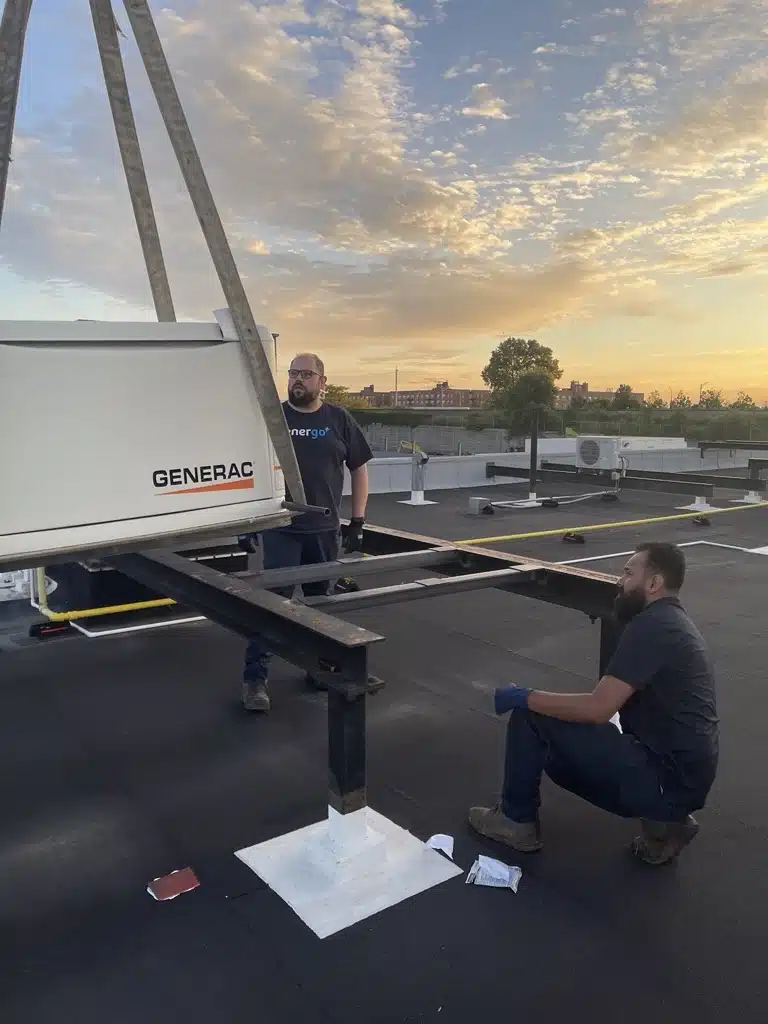
Rooftop placement makes the most sense when the site has little or no usable yard area, when basement flooding is a concern, or when fuel and exhaust can be routed without compromising other rooftop systems. The main advantage is that the generator is off the ground plane and usually away from trash, vehicle impacts, and tenant traffic. The main disadvantage is that the roof is never “empty” in NYC. FDNY requires perimeter access openings and a clear path across many roofs 100 feet or less in height, and that path must still reach bulkhead doors, fire escapes, skylights, ladders, and other rooftop features. If the layout cannot comply, the project may need a TM-5 rooftop-access variance.
Pros: Good flood resilience, no loss of side-yard circulation, and cleaner separation from street-level activity.
Cons: Heavy structural review, crane picks, roof-access conflicts, and more expensive maintenance logistics.
Key code / permit points: Preserve FDNY roof access; comply with zoning screening rules; and, if the generator is in an outdoor fenced area with main service equipment, expect DOB review through a Construction Code Determination request.
Complexity: High.
Main safety risks: Structural overload, blocked firefighting access, carbon-monoxide re-entrainment at penthouse openings, and difficult refueling for diesel units.
Basement and mechanical room placement
An interior generator room can work well when a building already has a serviceable mechanical core, a realistic exhaust path, and enough room for fuel-system components, acoustic treatment, and service clearance. This option is analytically attractive because it can simplify acoustics and weather protection, and diesel day-tank systems are familiar to engineers. But it is the most demanding option from a life-safety and mechanical standpoint. DOB materials point to dedicated rooms, special inspections, chimney review, fuel-oil system testing, and coordination with fire-rated construction. FDNY study material also requires smoke and heat detection, automatic suppression, portable extinguishers, and no combustible storage in fuel-oil tank and equipment rooms.
Pros: Best acoustic control and reliable indoor access for service.
Cons: Hardest exhaust and ventilation design; flood vulnerability in some buildings; more fire-protection requirements.
Key code / permit points: Enclosed areas must vent exhaust outside; fuel rooms need detection and suppression; and flood-zone projects must keep new equipment above DFE unless an allowed floodproofed design is used.
Complexity: High.
Main safety risks: Carbon-monoxide migration, heat buildup, exhaust backpressure errors, and fuel leaks in occupied buildings.
Exterior and side-yard placement
For many owners, the intuitive answer is “put it outside in the yard.” In NYC, that is only partly right. The 2025 DOB zoning bulletin says fossil-fuel generators accessory to buildings other than one- and two-family residences must be completely enclosed within a building or other structure, and still screened where required. At grade, equipment and screening in required side or rear yards cannot exceed 25 percent of that yard area, equipment must generally stay at least 5 feet from a lot line, and it cannot sit in front of legally required windows. That makes exterior placement workable on some lots, but not on many apartment-house lots with narrow side yards or deep window courts.
There is one narrow streamlined path worth knowing: DOB Buildings Bulletin 2018-005 covers one outdoor diesel-fired generator with an integrated UL 142 tank at grade outside the building, limited to 135 gallons or less, with DOB approval followed by an FDNY fuel-oil permit. The bulletin expressly does not apply to rooftop installations.
Pros: Usually easiest fuel delivery and service access.
Cons: Tight zoning geometry, neighbor noise exposure, and exposure to vehicle impact or vandalism.
Key code / permit points: Enclosure, screening, yard coverage, window clearance, lot-line setbacks, and FDNY fuel permits if oil is stored on site.
Complexity: Medium to high.
Main safety risks: Noise complaints, exhaust at neighboring windows, flood exposure, and poorly protected fuel systems.
Fuel, ventilation, noise, and access
For fuel choice, natural gas is often the least cumbersome operationally if utility capacity exists. The current Electrical Code says emergency generators relying on natural gas, where allowed by the Building Code, do not need an on-site fuel supply. Diesel remains attractive where owners want fuel on site, but that choice adds fuel-oil rooms, tanks, piping, permits, and inspection obligations. Manufacturer guidance from Generac and Kohler also shows that many standby models are available in natural-gas, LP-vapor, or diesel configurations, but the exact clearances and fuel-system rules remain model-specific. In dense NYC multifamily settings, LP should be treated as a special-case path, not a default assumption, because FDNY regulates LPG storage and handling aggressively.
Ventilation and exhaust are non-negotiable. Enclosed installations must operate in a well-ventilated area and vent exhaust outside, and its installation drawings explicitly account for fresh-air intake, cooling-air discharge, silencers, thimbles, and flexible sections. Even outdoor units must be placed so exhaust does not blow into occupied openings or air intakes. Generac’s residential standby generator guidance emphasizes clearance from openings and front service space.
Noise is not only a neighbor-relations problem. DOB’s zoning bulletin says accessory fossil-fuel generators must attenuate noise as regulated by the NYC Department of Environmental Protection, and DEP’s noise guidance for exterior circulation devices uses 42 dBA for a single device and 45 dBA cumulative at a nearby open window as a practical benchmark for nearby residences. Complaints route through 311.
Access is the last major filter. Roofs must keep FDNY clear paths open. Mechanical and electrical rooms must preserve working space, and larger electrical-service spaces can require two means of egress from the working space. Manufacturer literature also consistently requires enough room for inspection and maintenance. A generator that “fits” but cannot be safely serviced is a bad placement choice.
Permits, approvals, and when to hire a licensed team
The FDNY is only one of several reviewers. Permanent backup-power work requires licensed trades and permits through DOB, and emergency backup power projects often require special and progress inspections. DEP filings are separate: emergency and portable generators 40 kW and up require DEP registration, while stationary generators 450 kW and up require a DEP work permit and certificate to operate. Diesel fuel storage cannot be operated until FDNY issues the required fuel-oil permit, and FDNY will not issue that permit without proof of DOB approval. If rooftop lifting or sidewalk occupation is needed, the NYC Department of Transportation may also be in the picture, and after-hours work requires a DOB After Hours Variance.
For multifamily and apartment buildings, the recurring constraints are predictable: required windows facing yards, narrow lot lines, crowded roofs, active tenants, and little tolerance for noise or service interruptions. That is why owners should bring in a New York licensed PE or RA, licensed electrician, licensed master plumber, and, where applicable, a licensed oil-burning installer at the concept stage, not after a contractor has already picked a pad location.
Next steps for property owners
Use this short checklist before anyone orders equipment:
- Commission a site assessment by a PE or RA and the licensed trades. Verify structure, flood-zone status, available clear paths, window conflicts, electrical load, and fuel-routing feasibility.
- Choose the placement first, then the generator model. In NYC, location rules can eliminate otherwise suitable equipment.
- Confirm fuel strategy early: gas utility capacity for NG, compliant tank and piping layout for diesel, or whether LP is even worth pursuing.
- File DOB documents and inspections, apply for any FDNY fuel permits, and complete DEP CATS filings if the unit hits air-permit thresholds.
- Put a maintenance contract in place on day one, including exercise testing and recordkeeping. NYC Electrical Code requires periodic testing and written records on site.







How to Read a Heating Oil Tank Gauge: What Full, 3/4, 1/2 and 1/4 Mean
Most traditional heating oil tank gauges show your fuel level as a fraction, usually Full, 3/4, 1/2, 1/4 and Empty. The indicator inside the gauge moves down as your heating oil level falls.
Capped vs. Fixed Heating Oil Pricing: Which Should You Choose?
Capped heating oil pricing sets a maximum price per gallon while allowing you to pay a lower price when the plan’s pricing formula falls below that ceiling. Fixed heating oil pricing locks in one per-gallon rate for the agreed term, even if market prices rise or fall.