Sizing a commercial generator in NYC starts with what you actually need to power
If you are evaluating commercial generator installation NYC, start by identifying which “backup power” category your building is dealing with: emergency power systems (life safety), legally required standby, or optional standby. NYC guidance distinguishes these categories because they drive required response time, separations, and how the system can be wired into the rest of the building.
A practical sizing process for building owners and facility teams:
- Define the continuity target. List the functions that truly need to run during an NYC power outage (life safety, security, sump, network/telecom rooms, key elevators, critical tenant loads, refrigeration, medical, access control, etc.). If you “back up everything,” you almost always pay for a much larger generator, switchgear, and distribution upgrades than you need.
- Build a critical-load schedule. Capture each load’s running kW, voltage/phase, and whether it is a motor load (fans, pumps, compressors, elevators). Motor starting is where undersizing happens. One engineering reference used widely in the industry notes motor starting current can be several multiples of running current, and that this inrush can cause voltage dip that impacts other systems.
- Account for starting kVA and sequencing. Decide which motors can be started in a sequence (staggered starts), which need soft-start/VFD, and which must start immediately. This is often the difference between a right-sized solution and a generator that trips under real conditions.
- Choose the transfer strategy and architecture. A backup system is not just a genset. In NYC, an automatic transfer switch (ATS) is a core device in backup power systems and is explicitly called out as a major component in the City’s emergency backup power system overview.
- Validate capacity for concurrent loads. NYC code amendments and guidance emphasize that emergency and standby systems need capacity to supply all equipment required to be operational at the same time. That is a sizing check many teams miss when they rely on “nameplate sum” alone.
- Avoid the two classic failures: undersizing and chronic oversizing. Manufacturer guidance warns that undersizing often comes from underestimating starting requirements, but oversizing can create its own reliability issues, including poor operating efficiency and diesel wet stacking risk at very low load factors.
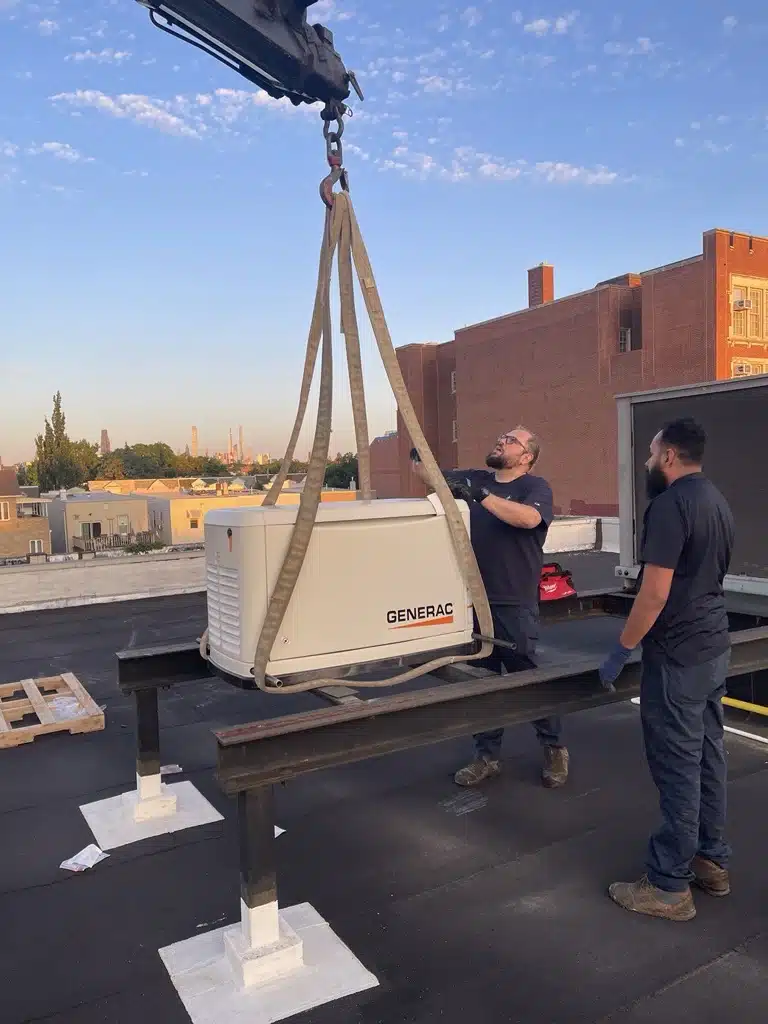
- Pressure test the plan against your building’s constraints. Roof access, crane picks, exhaust routing, noise constraints, and where the ATS and emergency distribution can physically fit can all force design changes that impact the final kW.
What to prepare before a site assessment (so you get an accurate quote): a one-line electrical diagram (if available), recent panel schedules, elevator and pump specs, a list of critical spaces/tenants, known constraints on roof or cellar access, and any existing emergency power infrastructure. NYC filings and inspections are tightly tied to scope, so clarity upfront reduces redesign and refiling.
Fuel choices for NYC businesses: diesel vs natural gas vs propane
NYC’s own owner-facing backup power guidance notes that most generator units run on diesel or natural gas, but the best choice depends on your building’s risk profile, operational needs, and compliance pathway.
Fuel Comparison Table
| Fuel type |
Best fit when |
Pros |
Trade-offs to plan for |
| Diesel (ULSD) |
You need maximum runtime control, on-site autonomy, or code-driven on-premises fuel |
On-site fuel can support longer outages; strong power density; common commercial standard |
Fuel storage and transfer systems can be code-intensive; refueling logistics; emissions and air filing requirements may apply |
| Natural gas |
You want long duration without on-site liquid storage and have robust gas service capacity |
No on-site liquid tank; steady fuel supply during normal conditions |
Utility dependency; capacity upgrades can be a schedule driver; allowed as sole fuel in specific code cases, not universally |
| Propane (LPG) |
You cannot store diesel and natural gas is not viable, and your site can legally store LPG |
Cleaner storage than diesel in some cases; works where natural gas is not available |
LPG storage and handling is heavily regulated in NYC; permits and Certificates of Fitness can apply; placement restrictions can be limiting |
A few NYC-specific realities to keep in mind:
- On-site fuel autonomy is not optional in many situations. NYC guidance for emergency and standby systems includes an on-premises fuel supply expectation measured in hours at full-demand, with limited exceptions where utility natural gas may be permitted as the sole fuel supply in specific cases.
- Gas and propane generators can be subject to derating and sizing impacts. An engineering sizing reference notes that gas or LP units may need to be oversized due to derating, which can change both equipment footprint and budget.
- Propane storage is a permitting topic, not just an equipment choice. Fire Department of the City of New York provides a specific LPG permit threshold (quantities exceeding 400 standard cubic feet, approximately 47 lbs) and describes that stationary propane storage permitting can involve DOB-approved plans submitted to FDNY for review plus inspections and billing steps.
- Diesel storage and transfer can introduce additional compliance steps and ongoing obligations. NYC code sections governing fuel-oil tanks above certain locations include requirements such as a dedicated 2-hour rated room/enclosure, sprinklers, smoke detection, ventilation, containment, transfer pumps, alarms, and even weekly testing for certain controls. That is why “diesel generator” projects often include more than just a genset and a pad.
NYC permits and approvals: what to expect and what usually slows projects down
In NYC, the permitting story is rarely “one application, one inspection.” City guidance for emergency backup power systems repeatedly emphasizes that permanent installation work generally requires permits and properly licensed trades.
The agencies and approvals you should plan for
Department of Buildings filings and permits
Permitting and licensing expectations for emergency, standby, and optional systems, and note that emergency commercial generator installations can require multiple permits (for example, both an electrical permit and a construction work permit), issued to appropriately licensed contractors.
Electrical work is a distinct permitting track. An electrical permit is required for most electrical work, must be performed by DOB-licensed contractors, and that all ED16A electrical filings must be submitted through DOB NOW: Build.
Special inspections and acceptance testing
For emergency and standby power systems, NYC Building Code special inspection language specifically includes generators and requires witnessed tests to verify automatic operation in accordance with NFPA 110 and NFPA 111. This is not paperwork you want to discover late in the project.
Air filings for stationary engines and generators
NYC Department of Environmental Protection publishes filing thresholds for engines, generators, and turbines. As of a March 2026 revision, stationary generators at 40 kW or greater can trigger NYCDEP filing requirements (registration for certain ranges; work permit/certificate to operate for larger units), and the guidance also defines “emergency generator” in a way that excludes demand response or peak shaving participation.
Fuel permits and Certificates of Fitness
NYC’s emergency backup power “key project terms” guidance notes that when storage of flammable and combustible liquid exceeds 10 gallons, an FDNY permit is required, and a Certificate of Fitness is required for a person supervising or performing fuel transfer to fill the storage tank.
Noise planning
Backup generators can create noise and vibration concerns, especially when installed near residences or on rooftops. NYC’s Noise Code page notes shared enforcement between DEP and the Police Department. In DOB’s emergency backup power design guidance, “sound transmission/noise control requirements” are explicitly flagged as a design consideration.
Typical timelines and why “permits” is the long pole
Every building is different, but in NYC the longest delays commonly come from a combination of (1) incomplete load definition causing redesign, (2) coordination across trades and agencies, (3) special inspection planning, and (4) air and fuel compliance steps that only apply once the equipment size and fuel are finalized. DOB’s own checklists emphasize reducing deferred submissions, showing key requirements clearly, and preparing supporting documents in advance to avoid repeat reviews and construction delays.
1. Site assessment
The process starts with a review of the building, the available space, access points, electrical setup, fuel options, and the systems that need backup power.
2. Design and load study
Next comes system design. This includes reviewing essential loads, startup demands, transfer equipment, and generator sizing so the system matches the building’s actual needs.
3. Permits and filings
Before installation begins, the project typically moves through the required permit and filing process. This may include electrical, construction, fuel, and other approvals depending on the building and equipment.
4. Installation
Once approvals are in place, the generator, transfer equipment, fuel components, and related backup infrastructure are installed.
5. Inspection
After installation, the work is inspected to confirm it meets applicable requirements and is ready for startup.
6. Commissioning
The system is then tested and commissioned to make sure it starts properly, transfers power correctly, and performs the way it should under real operating conditions.
7. Service and maintenance
After the system is up and running, ongoing service helps protect reliability. Routine maintenance, testing, and inspections are what keep a backup generator ready when an outage actually happens.
Design details that matter in NYC buildings: ATS, placement, access, and sound
For commercial buildings, generator projects succeed when design matches the physical and regulatory constraints of the property.
ATS location and system separation
ATS function senses power loss, commands the generator to start, and transfers load. NYC’s project category guidance distinguishes emergency systems as requiring separation and dedicated equipment and wiring pathways, while optional standby systems can share some components. That distinction affects how much switchgear, conduits, and panel work you will pay for.
Generator rooms, fire separations, and what can share the space
NYC guidance limits what can be located in an emergency generator room and calls out a 2-hour fire resistance rated room for emergency generators, with tight restrictions on what piping is allowed in that room. If your building lacks “spare” rated space, this alone can drive layout decisions and cost.
Diesel day tanks and fuel transfer systems are a project inside the project
If your solution includes fuel-oil tanks above certain building levels, the code requirements can include dedicated rated rooms, sprinklers, smoke detection, ventilation, secondary containment, transfer pumps, and alarms. Plan for mechanical and fire protection scope, not just electrical.
Noise, vibration, and neighbor risk
Generator sound is not just a comfort issue. Depending on adjacency and building type, mitigation can become part of the filing package. DOB’s checklists reference “sound mitigation plan” among supporting documents that may be required for projects, and NYC’s Noise Code enforcement structure means complaints can become operational issues after install if the design is not robust.
Service expectations and ongoing costs: what ownership looks like after installation
A generator is a mechanical and electrical system that needs routine exercising, inspection, and periodic testing. In NYC, the system also needs to be “provable” during inspections and, depending on system type, during special inspection witnessing and acceptance testing.
The baseline testing rhythm
Industry materials that reproduce NFPA 110 requirements note that generator sets in service are exercised at least monthly for a minimum run time, with load requirements tied to exhaust temperature guidance or minimum percent loading. Even if your building’s system is “optional standby,” most owners adopt a similar operational cadence because batteries, coolant heaters, fuel quality, and ATS function can degrade quietly over time.
Budgeting service and maintenance
Your ongoing costs typically include scheduled inspections and tune-ups, battery and consumables replacement, periodic load bank testing depending on your load profile, and corrective repairs. If you use diesel, add fuel quality management and refueling logistics. If your generator is large enough to trigger NYCDEP registration or permitting, renewals and documentation also become part of the lifecycle planning.
Service agreements are an operational decision, not a nice-to-have
For facility teams, a “generator service agreement” is often how you convert unpredictable emergency calls into a predictable maintenance program with documented testing and faster response when something fails. This is especially important when your backup power supports life-safety loads or high-value business continuity functions.
If you are planning a commercial generator installation in NYC and want a code-aligned design, permitting support, and long-term service, Energo provides commercial generator solutions that span site assessments, system design, installation, fuel sourcing, maintenance, and repairs.







How to Read a Heating Oil Tank Gauge: What Full, 3/4, 1/2 and 1/4 Mean
Most traditional heating oil tank gauges show your fuel level as a fraction, usually Full, 3/4, 1/2, 1/4 and Empty. The indicator inside the gauge moves down as your heating oil level falls.
Capped vs. Fixed Heating Oil Pricing: Which Should You Choose?
Capped heating oil pricing sets a maximum price per gallon while allowing you to pay a lower price when the plan’s pricing formula falls below that ceiling. Fixed heating oil pricing locks in one per-gallon rate for the agreed term, even if market prices rise or fall.