Traffic and Congestion
It’s no surprise that traffic is challenge #1 with heating oil delivery in NYC. A delivery route that might take an hour elsewhere can easily double in the city due to traffic jams. There are only so many trucks and drivers, and only so many hours in a day to make deliveries. In peak winter, when everyone’s tank is getting low at once, congestion can delay trucks significantly.
Think about a typical day: A truck leaving a Queens terminal has to make stops in Brooklyn and Manhattan. En route it faces rush hour on the BQE, then crawling crosstown traffic in Manhattan. If a severe cold snap hits, this is compounded – more trucks on the road, possibly night deliveries to catch up, and even extra shifts with overtime. One cold wave can “compress a month’s worth of demand into a few days.” Fuel companies in the NYC area often pay drivers overtime and run trucks late into evenings to fulfill all orders, which in turn can slightly raise costs (similar to surge pricing).
How It’s Managed
Route optimization software is a must – dispatchers plan routes to avoid worst congestion times and cluster deliveries by area. Many companies will schedule off-peak deliveries (overnight or early morning) for commercial clients or tank fills that are accessible at those times, to spread out the workload. Also, NYC-savvy drivers know shortcuts and timing (for example, avoid certain avenues during school dismissal hours, take the waterfront route if the highway is jammed, etc.). Some suppliers station trucks in multiple boroughs so they don’t have to cross bridges during peak hours. Still, traffic is an ever-present factor, and customers are advised: in a deep freeze, allow a bit of extra time for your delivery because gridlock can slow everybody down.
Parking and Building Access
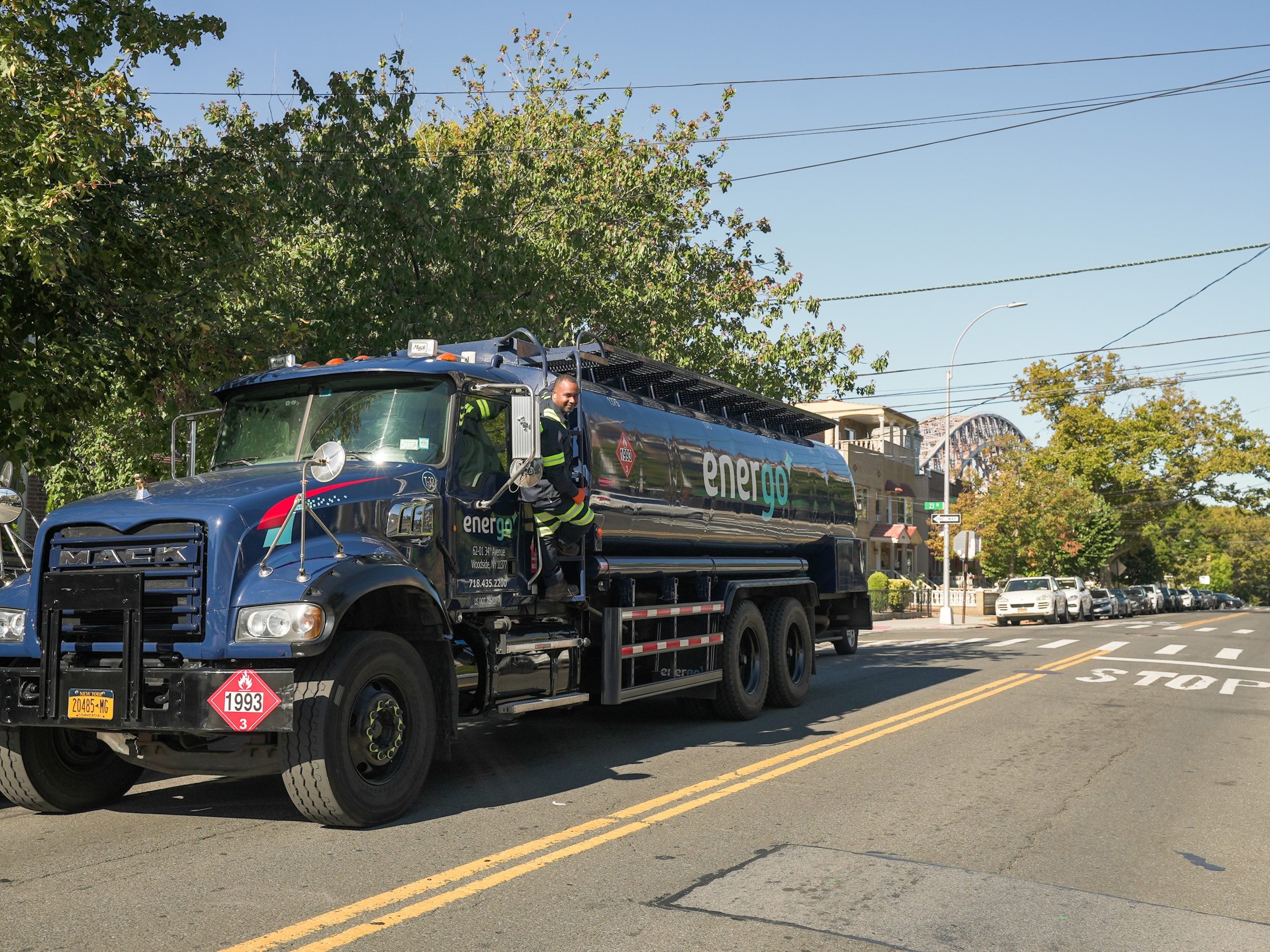
In dense neighborhoods, just finding a place to park a 30-foot oil truck can be an ordeal. Many NYC streets have restricted parking, and curb space is often filled with parked cars. Unlike a UPS van that can slide into a double-parked spot for a minute, an oil truck needs to occupy space for a longer period while hooking up hoses and pumping hundreds of gallons.
Double Parking
Frequently, oil deliveries involve double-parking on narrow residential streets. This can block traffic, so drivers must be quick and careful. They put out cones and hazard lights, and often coordinate with building supers to expedite the process. In Manhattan, sometimes police will allow temporary double-park if it’s a known delivery route, but other times drivers risk tickets – which the company has to absorb as a cost of doing business.
No Driveways
Unlike suburban homes where a truck can pull into a driveway or off the road, in NYC the fill pipe might be at the front of the building along the sidewalk. The truck has to align close enough for the hose to reach. Hoses can be long (150+ feet), but winding them around corners or parked cars adds difficulty. Imagine running a thick hose down a street, between cars, into a cellar fill point – it requires skill to avoid scratching vehicles or tangling the hose.
Solution Approaches
Many deliveries are scheduled for times when parking is a tad easier (mid-morning after alternate-side parking shuffle, or early afternoon lull). Some companies have smaller trucks or “mini tankers” that can fit in tighter spots where a full-sized truck wouldn’t. These smaller trucks carry less fuel but are more maneuverable in old neighborhoods with narrow streets (think sections of Brooklyn like Red Hook or certain Bronx enclaves). Drivers also sometimes coordinate with each other – for instance, if two trucks are on the same block, they might block the street at both ends briefly to safely do their fills, then depart. While this annoys honking drivers for 10 minutes, it actually speeds up the process and is safer than one truck navigating while cars squeeze by.
Narrow Streets and Low Clearances
New York has old, narrow streets especially in areas like the West Village, Little Italy, or parts of Brooklyn (e.g., Carroll Gardens). Maneuvering a heavy truck through these can be white-knuckle. Tight turning radii can be a real challenge – trucks sometimes have to take wider paths or even reverse out if there’s no through-street.
Then there are clearance issues: some older elevated train lines or parkway bridges (especially heading to outer boroughs) have low clearance that trucks must avoid. NYC trucks know not to take the parkways (which have low bridges) – they stick to truck routes, but detouring to truck routes adds to travel time.
Adaptations
Fuel companies use detailed GPS maps that mark truck-approved routes. Drivers are extensively trained on NYC geography – for example, knowing that Trucks can’t use the Brooklyn Bridge (must take Manhattan or Williamsburg Bridge instead) and avoiding certain residential streets that aren’t truck-legal. This ensures they don’t get stuck or ticketed. For narrow streets, sometimes using a longer hose allows the truck to stay on a wider cross street and reach a building mid-block. Drivers also often have a helper who can spot and guide them through tight spots, which improves safety.
Weather Complications in the City
Urban delivery is further complicated by snow and ice. After a heavy snow, NYC streets lose parking lanes to plowed snowbanks, effectively getting even narrower. Turning corners with snow piles can be treacherous. In a “snow emergency,” some roads might be temporarily closed or restricted. Oil trucks may need chains on tires to get up slick hills. All this can delay deliveries and reduce how many stops a truck can make in a day.
During a snowstorm, blocked streets (due to stuck cars or unplowed roads) are common in outer boroughs. Oil trucks could find they can’t reach a particular street and have to reschedule that delivery. Additionally, if hydrants are being cleared or city plows are active, trucks must work around those operations.
Companies prepare by having drivers start earlier on snow days, equipping trucks with snow tires or chains, and prioritizing automatic delivery customers so they get refills before a storm hits (preventing emergency calls). They also coordinate with city services – e.g., if a street is unplowed, sometimes a quick call can get a plow to clear a path so essential fuel deliveries can continue. It truly becomes an “all hands” operation during extreme weather.
Coordinating with Building Staff
In a dense urban environment, many buildings (especially larger apartments) have building superintendents or managers who facilitate deliveries. Access to the fill pipe might require someone to unlock a hatch or ensure the correct tank is being filled (some buildings have multiple tanks). Timing deliveries when building staff are on duty is important.
For instance, a truck arrives at a large co-op – the super needs to disable the boiler briefly (common practice) to prevent the burner from firing while new oil is being pumped in (to avoid stirring up sludge into the burner line). The super might also need to swap which tank is active if there’s a multi-tank oil system (some buildings alternate tanks). All this requires communication and timing.
If a delivery arrives and no one’s home (no super), and the fill is locked, the truck can’t deliver and that’s a wasted trip in a busy schedule. To avoid this, companies and building managers work out delivery windows.
Many NYC customers on automatic delivery give their oil company a key to the fill cap or ensure an unlocked fill. Some systems are entirely exterior and accessible, which simplifies things. However, with basement tanks, sometimes the driver needs access inside to verify the tank level or to reset the gauge after filling. Coordination is key – miscommunication can lead to missed deliveries or even fuel spills if, say, an improperly maintained tank overfills.
Safety and Regulations
The city environment adds regulatory layers. Trucks can’t idle more than 3 minutes per NYC law (though actively pumping fuel might be an exception, they often still try to minimize engine idling). They must also follow strict weight limits on certain roads.
Delivering in dense areas means being mindful of pedestrians at all times – running a hose across a sidewalk requires cones or a staff member standing guard so no one trips. Any spill, even a few drops, on a busy sidewalk needs immediate cleanup for safety and to avoid public complaints.
NYC’s Department of Consumer and Worker Protection (DCWP) also keeps an eye on oil deliveries – they inspect truck meters annually for accuracy and seal them. They enforce that receipts with exact gallons delivered are given, etc. So there’s oversight ensuring that even in the chaotic urban setting, consumers get what they pay for and are protected from scams (in the past, unscrupulous operators might have shorted deliveries in the confusion of difficult delivery conditions – but the city’s checks and heavy penalties have largely curbed this).
Ensuring Reliable Delivery Despite Challenges
With all these challenges, how do suppliers keep oil flowing reliably in NYC?
- Experience: Companies that have been delivering in NYC for decades know the drill. Their drivers often have 10, 20+ years experience in city driving.
- Technology: GPS routing, real-time traffic updates, and route management software help adapt to changing conditions hourly.
- Staging: During peak demand, suppliers may stage trucks in different neighborhoods ready to go.
- Customer Communication: Urban customers often benefit from tighter delivery windows or notifications.
- Maintenance: City driving is tough on trucks, so reputable companies keep fleets in top shape.
- Crew Size: Some urban deliveries use two-person crews to speed setup and improve safety.
Despite the madness of NYC streets, suppliers manage to deliver thousands of gallons daily all winter. Residents can help by ensuring clear access – for example, if you have a driveway or alley where a smaller truck could fit, let your oil company know. Or if your fill is in a sidewalk hatch, keep the area clear of debris or ice. Little things matter.
In dense neighborhoods, heating oil delivery is truly a feat of coordination and urban savvy. Next time you see an oil truck squeezed between parked cars with hose snaking into a building, you’ll know the dance that’s required to perform that delivery. It may not be easy, but with experience and city-smart strategies, NYC oil suppliers get the job done winter after winter.





NYC Local Law 88: Lighting, Submetering & LL88 Report Requirements
If you own or manage a NYC building over 25,000 square feet, Local Law 88 is one of the four building energy laws you have to think about — and it’s the one most owners understand the least. LL88 requires two things: upgrading the building’s lighting to meet the current NYC Energy Conservation Code, and installing submeters for non-residential tenant spaces over 5,000 square feet.
Why Is My Central AC Not Cooling? NYC Homeowner Guide
If your central AC is running but not cooling, the cause is usually one of a short list: the thermostat is set wrong, the filter is clogged, a breaker or power issue is interrupting the system, the evaporator coil is frozen.